Download Oracle WebLogic Server 12c Essentials.1z0-599.ExamTopics.2026-08-09.22q.vcex
| Vendor: | Oracle |
| Exam Code: | 1z0-599 |
| Exam Name: | Oracle WebLogic Server 12c Essentials |
| Date: | Aug 09, 2026 |
| File Size: | 238 KB |
How to open VCEX files?
Files with VCEX extension can be opened by ProfExam Simulator.
Discount: 20%

Demo Questions
Question 1
WebLogic 12c, the Maven plug-in has been enhanced with which Maven goal?
- wls:unzip, wls:install-domain, wls:start-domain, wls:wlst, wls:appc
- wls:install, wls:install-domain, wls:start-domain, wls:wlst, wls:appc
- wls:unzip, wls:create-domain, wls:start-domain, wls:wlst, wls:appc
- wls:install, wls:create-domain, wls:start-server, wls:wlst, wls:appc:
Correct answer: D
Explanation:
wls-maven-pluginDelivered in WebLogic Server 12c, provides enhanced functionality to install, start and stop servers, create domains, execute WLST scripts, and compile and deploy applications.Reference: Developing Applications for Oracle WebLogic Server, Using the WebLogic Development Maven Plug-In
Question 2
You want to capture WebLogic internal events correlated with JVM events for viewing offline. What three actions must you take to enable this within WebLogic?
- Run WebLogic in a JRockit JVM and ensure the Flight Recorder is enabled.
- Configure the WebLogic Diagnostic Framework Event Volume to Low, Medium, or High depending on the type of events you want to capture.
- Configure the WebLogic Diagnostic Framework bridge to send events to the JRockit Flight Recording.
- Take a dump from the default recording or create a new recording for the time period you want to capture.
Correct answer: A, B, D
Explanation:
A: You can enable JFR at runtime to take JRA recordings from the JRockit Management Console. You also have the option of turning off the JFR and recordings at the JRockit JVM level from the java command line using:$ java -XX:-FlightRecorderB:* In most environments, there is little performance impact when the Diagnostic Volume is set to Low and the most performance impact if Diagnostic Volume is set to High. The volume of diagnostic data produced by WebLogic Server needs to be weighed against potential performance loss.* WLDF provides the Diagnostic Volume attribute to set the amount of code coverage that is enabled and the amount of data provided in the events that are generated for the covered codeThe following code example sets the volume to Medium:. . .connect()edit()startEdit()cd("Servers/myserver")cd("ServerDiagnosticConfig")cd("myserver")cmo.setWLDFDiagnosticVolume("Medium")save()activate()D: Integrated with the WebLogic Diagnostic Image and Watch and Notification systemEnables capture based on system state, event capture during event; no need to replicateWatch for stuck thread count, heap size increase, available memory, etc.Set up notifications: capture WLDF imageDiagnostic image capture spurs JFR file generation; JFR file included in diagnostic imageIncludes full JFR data from all event generatorsNote:* WebLogic Diagnostic Framework (WLDF) provides specific integration points with JRockit Mission Control Flight Recorder. WebLogic Server events are propagated to the Flight Recorder for inclusion in a common data set for runtime or post-incident analysis.Reference: Oracle Fusion Middleware Performance and Tuning for Oracle WebLogic Server, Tuning WebLogic Diagnostic Framework and JRockit FlightRecorder Integration -Reference: JRockit Flight Recorder & WebLogic Diagnostic FrameWork (WLDF) Integration
Question 3
Which new key architectural element introduced in WebLogic Server l2c should you take advantage of when designing Disaster Recovery Centers with active - passive mode?
- MAN Clusters, because they would allow you to synchronously replicate state in low latency networks
- WAN Clusters, because they would allow you to asynchronously replicate state in nonlow latency networks.
- Transaction Log in the database, because you could avoid synchronizing two replication technologies (database and file)
- Data Guard, because it is the most effective way to replicate a state across locations
- GoldenGate, because it is the most effective way to replicate a state across locations
Correct answer: E
Explanation:
* Oracle GoldenGateOracle GoldenGate is Oracles strategic product for data distribution and data integration. It is a highperformance software application that uses log-based bidirectional data replication for real-time capture, transformation, routing, and delivery of database transactions across heterogeneous systems.Note:* Oracle Active Data GuardOracle Active Data Guard 11g is an option of Oracle Database Enterprise Edition that extends basic Data Guard functionality. It allows a physical standby database to be open as read-only while changes are applied to it from the primary database. This increases performance and return on investment by offloading ad-hoc queries, Web-based access, reporting, and backups from the primary database while also providing disaster protection.* Disaster recovery (DR) procedures ensure rapid recovery or continuation of a technology infrastructure after a natural or human-induced disaster. Oracle WebLogic Server 12c supports advanced disaster recovery and business continuity. Organizations can store transaction logs in an Oracle database instead of a file system, providing a highly available storage mechanism to improve the speed and reliability of disaster recovery operations. This permits them to utilize Oracle Active Data Guard or OracleGoldenGate replication technology to move DR state information across data centers. Oracles enhanced DR architecture enables more effective recovery scenarios. Support for Oracle Exalogic and Oracle Exadata engineered systems ensures tremendous scalability for IT operations of any size.* Oracle WebLogic Server 12c places transaction logs on the database tier to improve the speed, reliability and availability of disaster recovery operations.
Question 4
Identify four features of WebLogic that provide value above and beyond a simple Java EE container.
- Active GridLink for RAC
- support for enterprise Web Services standards beyond Java EE specification
- Integration with Enterprise Manager
- market leading performance
- Java EE6 Specification Support
- Java SE 7 support
Correct answer: A, B, E, F
Explanation:
B: Java EE Enterprise Web Services is supported.E: New or enhanced WebLogic 12c features includeJAVA EE 6 support all kinds of JEE6 specifications are implemented like :JSF 2.0,Java Servlets 3.0 JPA 2.0 and EJB 3.1.Managed Beans 1.0 -F: WebLogic 12c also supports supports Java SE 7 (and Java SE 6).Java language optimizations and InternationalizationClient and server support -SSL/TLS 1.2 in JSSE to support JAVA Socket Transport securityConverged Java VM:JRockit and HotSpot are incorporated with the best features from both. Oracles Publisher Seminar 2011 during OOWIncorrect:not C:
Question 5
You want to migrate an application that was developed for OAS/OC4J to WebLogic. The application uses Oracle Streams Advanced Queuing (AQ). You configured a Foreign JMS Server and Data Source but you are not able to send messages to the AQ destination and see them reach the database. Which two things are missing in this configuration?
- nothing, there may be a network connection issue
- a Foreign JMS Connection Factory
- a JMS Bridge to map the JNDI of the Local JMS Destination to the remote AQ destination
- a mapping of the Foreign JMS Connection Factory to the Data Source where AQ is configured and installed.
- Oracle AQ Java EE Shared Libraries not deployed and referenced by your application
Correct answer: C, E
Explanation:
C:* A WebLogic Messaging Bridge communicates with the configured source and target bridge destinations. For each mapping of a source destination to a target destination, you must configure a messaging bridge instance. Each messaging bridge instance defines the source and target destination for the mapping, a message filtering selector, a QOS, transaction semantics, and various reconnection parameters.Note:* In your JMS Foreign Server configuration:/ Specify oracle.jms.AQjmsInitialContextFactory as the JNDI Initial Context Factory./ Configure the JDBC data sources needed for your application environment.
Question 6
In the area of Performance Management and Diagnostics, which feature is supported in Oracle Enterprise Manager 12C?
- Search information in logs across multiple domains
- View different log information in single console location
- Save current performance data as baseline to be used in comparison with future data
- Provides single dashboard across multi-tier composite application
Correct answer: A
Explanation:
Reference:http://docs.oracle.com/cd/E25178_01/fusionapps.1111/e14496/logs_diagnostics.htm
Question 7
Which two options best describe how the Maven Plugin for WebLogic enables WebLogic to be effectively used in a Continuous Integration environment?
- execution of unit and integration tests
- management of the life cycle of a WebLogic domain including creation, configuration, and server life-cycle management
- deployment and undeployment of applications
- Java profiling
Correct answer: A, C
Explanation:
Note:* Apache Maven is a software tool for building and managing Java-based projects. WebLogic Server provides support for Maven through the provisioning of plug- ins that enable you to perform various operations on WebLogic Server from within a Maven environment.* Continuous Integration is a software engineering practice which attempts to improve quality and reduce time to deliver software by applying small, frequent quality control efforts. It is characterized by these key practices:Use of a version control system -All developers commit to the HEAD (main code line) every dayThe product is built on every commitThe build must be automated and fastAutomated deployment to a production-like environmentAutomated testing -Results of all builds are published (so everyone can see who broke the build)Deliverables are easily available (for developers, testers, other stakeholders)
Question 8
You deploy two different applications to the WebLogic container. One application use Xerces parser version A and the other application uses Xerces parser version B. Both these versions are different from the parser version that the WebLogic server uses internally. You want to use the Filtering Classloader feature to solve this problem. What action would you take to generate proper filtering Classloader entries?
- Modify the applications to use the same version that WebLogic uses internally.
- Based on available examples of Filtering Classloader entries, try to modify get the proper entries.
- Deploy and use the Classloader Analyzing Tool to resolve all conflicts with conflicting libraries. This tool will generate all proper entries.
- Split the application into separate WebLogic containers and use different WLS versions of Xerces but identical that applications require.
- Look for a WebLogic release that uses the same version of Xerces that the applications use.
Correct answer: B
Explanation:
Note:* The FilteringClassLoader provides a mechanism for you to configure deployment descriptors to explicitly specify that certain packages should always be loaded from the application, rather than being loaded by the system classloader. This allows you to use alternate versions of applications such as Xerces and Ant.* To configure the FilteringClassLoader to specify a certain package is loaded from an application, add a prefer-application-packages descriptor element to the weblogic-application.xml which details the list of packages to be loaded from the application. The following example specifies that org.apache.log4j.* and antlr.* packages are loaded from the application, not the system classloader:<prefer-application-packages><package-name>org.apache.log4j.*</package-name><package-name>antlr.*</package-name></prefer-application-packages>Reference: Understanding WebLogic Server Application Classloading
Question 9
When you use WebLogic Management Pack EE, which three operations are enabled compared to managing WebLogic Server only through web console?
- management of many WebLogic Server Domains from a single web console
- tracking changes in the configuration of WebLogic Domain
- automation of provisioning process in the new environment
- checking compliance with the licenses that a customer has
- visual creation of JDBC DataSource object to Oracle RAC
Correct answer: A, B, E
Explanation:
The WebLogic Server Management Pack EE greatly improves application performance by providing unique functionality to automatically detect performance bottlenecks; quickly diagnose these performance problems, and identify their root cause. Key application performance management features of the pack include the following:* (A) Manage multiple farms and WebLogic Domains centrally* Monitor Oracle Coherence Cluster including all nodes within a cluster, all caches, services, connection managers and connections* Monitor middleware availability and performance out-of-box; track such data historically, and receive notifications of potential problems* Obtain real-time, in-depth JVM diagnostics without instrumentation overhead* Trace transactions across containers as well as to the database* (E) Analyze call paths and dependencies via graphical, architecture views* (E) Automatically discover and model dependencies between Java components, frameworks, and web servicesReference: Weblogic Server Management Pack Enterprise Edition
Question 10
In a Java EE messaging application, one MDB is consuming a lot of memory at high traffic.
What configuration should you use to prevent possible out-of-memory error at high traffic and at the same time not losing messages?
- Configure a Work Manager for the MDB with a Maximum Thread Constraint.
- Configure a Work Manager for the MDB with a Minimum Thread Constraint.
- Configure a Work Manager for the MDB with a Maximum Thread Constraint and a Capacity Constraint.
- Configure a Work Manager for the MDB with a Minimum Thread Constraint and a Capacity Constraint.
- Configure a Work Manager for the MDB with both a Maximum Thread Constraint and Minimum Thread Constraint.
Correct answer: B
Explanation:
Note:** When to Use Work ManagersFollowing are guildelines to help you determine when you might want to use Work Managers to customize thread management:/ The default fair share is not sufficient.This usually ocurrs in situations where one application needs to be given higher priority over another./ A response time goal is required./ A minimum thread constraint needs to be specified to avoid server deadlock
Question 11
A customer is developing a custom application that involves a multistep provisioning process for a new account. There is a custom Java client application that is generating multiple JMS messages as part of the process and sending them to the WebLogic tier where they are processed.
Which three steps must you take to implement the solution to allow for scalability and parallel processing of multiple simultaneous provisioning requests while ensuring messages for an individual process are not delivered out of order?
- Update the client application that is creating the JMS messages to use Unit of Work.
- Configure a WebLogic Cluster for Distributed JMS.
- Update the client application that is creating the JMS messages to use Unit of Order.
- Enable XA Transactions on the JMS Connection Factory used by the client application.
- Enable Load Balancing on the JMS connection factory used by the client application.
Correct answer: B, C, D
Explanation:
C: Message Unit-of-Order is a WebLogic Server value-added feature that enables a stand-alone message producer, or a group of producers acting as one, to group messages into a single unit with respect to the processing order. This single unit is called a Unit-of-Order and requires that all messages from that unit be processed sequentially in the order they were created.D Transactions required for parallel processing.Incorrect:A: Many applications need an even more restricted notion of a group than provided by the Message Unit-of-Order (UOO) feature. If this is the case for your applications, WebLogic JMS provides the Unit-of-Work (UOW) Message Groups, which allows applications to send JMS messages, identifying some of them as a group and allowing a JMS consumer to process them as such. For example, an JMS producer can designate a set of messages that need to be delivered to a single client without interruption, so that the messages can be processed as a unit. Further, the client will not be blocked waiting for the completion of one unit when there is another unit that is already complete.Note:* WebLogic JMS defines two default connection factories, which you can look up using the following JNDI names: weblogic.jms.ConnectionFactory weblogic.jms.XAConnectionFactoryReference: Using Message Unit-of-Order
HOW TO OPEN VCE FILES
Use VCE Exam Simulator to open VCE files
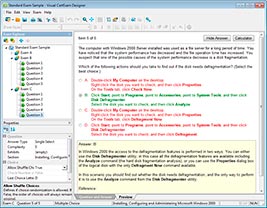
HOW TO OPEN VCEX AND EXAM FILES
Use ProfExam Simulator to open VCEX and EXAM files
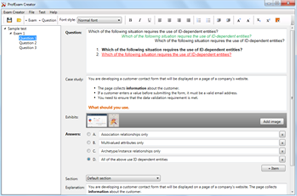
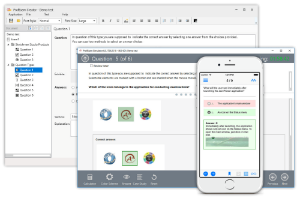
ProfExam at a 20% markdown
You have the opportunity to purchase ProfExam at a 20% reduced price
Get Now!